Howard Hartley

Writing & Reflections

Step into the wider world behind The Mantonovan Chronicles. Here you’ll find thoughts from Howard Hartley on the writing of Sir Edric, the powers of Earth and Sol, the kingdoms and histories that shape Mantonova, and the ideas that sit behind the series.

From introductions to the world and its characters to reflections on storytelling, history, conflict and imagination, this space offers a closer look at the craft and inspiration behind the books.

Filter by category

Howard Hartley
World of Mantonova
Behind the Books
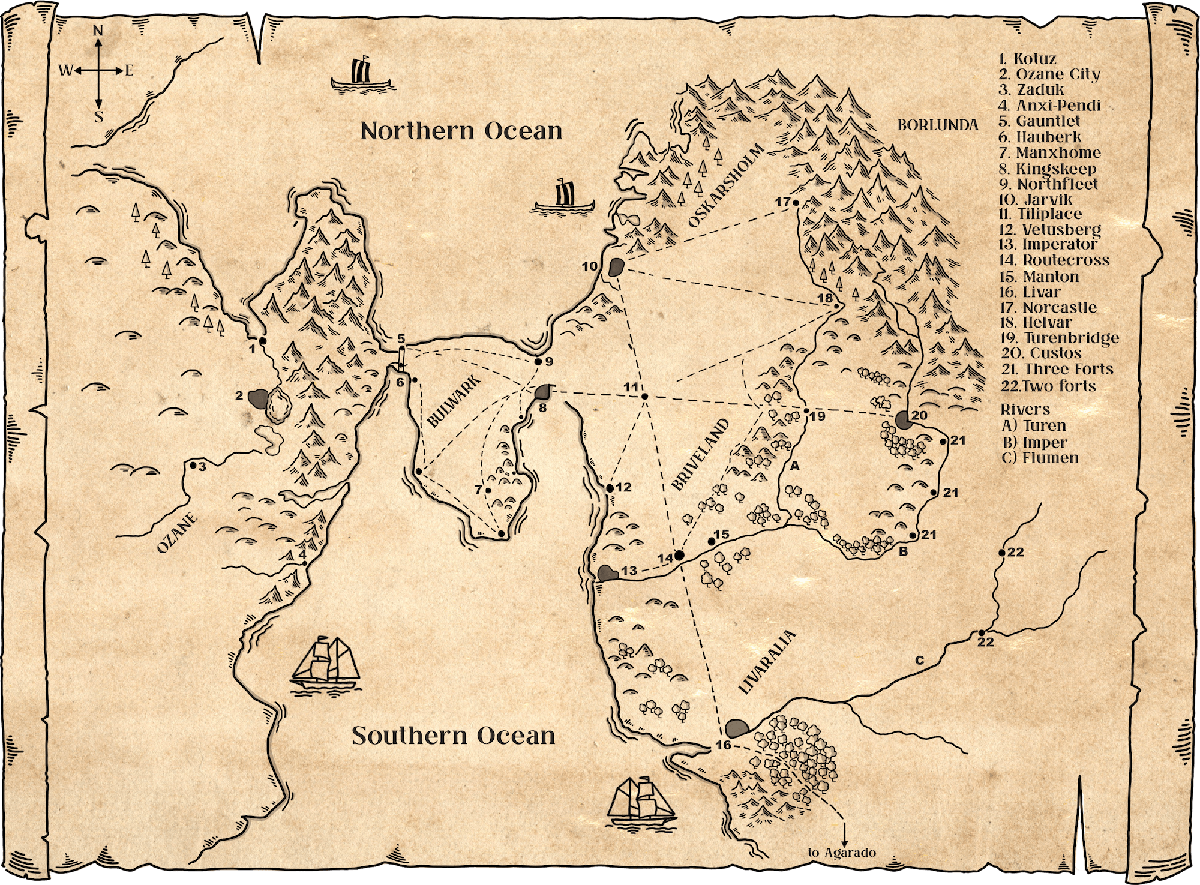
A map of Mantonova
World of Mantonova

An Introduction to the World of The Mantonovan Chronicles

A thousand years ago (then), a revolt in Agarado allowed several hundred slaves to wrest their freedom from the tropical Empire of Sol and escape to the temperate north. Their descendants have prospered and have become the Free Countries: a loose alliance of kingdoms that have come to worship Earth. 

The Empire of Sol was a cruel theocracy, ruled by a priesthood whose teachings reflected its climate: hot, fierce and unforgiving.  They teach that:

“The world was water, and Sol boiled away much of the water to create land. He warmed the land, making it fertile. The water that He boiled away is carried in the clouds that travel across the sky to do His bidding and shed themselves to keep the land damp and good for crops.  He made people to tend the land, and to them He gave the land, telling them to use it well in His honour.  He gave them much land, too much for them to tend, and He ordered them to go out and find others who did not worship Him and cause them to work upon the land in service to the masters of the land, the servants of Sol.  It is said that when the entire land He has given is used properly, then shall He lead His devout to new lands and cause them to strive again until the entire world is brought into use in His name.”

In the north, sunlight is gentle, warming the backs and shoulders of the population without burning them, so Earth wears a gentler mien: Sol’s power is so weak as to be insignificant; It has been forgotten. The opening verses of the Code of Earth state:

“In the beginning, there was sea. The sea receded and gave up land, and Earth gave the land life, causing corn to grow and beasts to graze. Earth summoned men from the mountains, and to these, he gave the land to hold for It, giving them this command:

“This land is yours to hold and to people.  Hold it in My name and by My code, and it will prosper.  If it is held other than in My name, so shall the seas rise again and cover the land, destroying all in it and on it.”

The first four books of the series tell of the struggle of those slaves who fought for their freedom and gave birth to what would develop into the Free Countries. 

The four books also relate the tale of now, a thousand years later, when the Free Countries face another existential threat. For two hundred years, the Despotate of Ozane, a populous slavocracy with a vast army, has threatened the western border of Bulwark, the most western Free Country.

 Free Country weaponry, however, is born of nations that encourage invention and innovation. Ozane, however, suppresses any deviation from the fundamental disciplines imposed by the despot. Free Country weapons, martial training and skills are therefore so superior that no invasion can succeed: it’s a stalemate/ The despot still orders slaving raids, however, stealing women of childbearing age and killing men and older women, to expand the population of Ozane. Now, however, an Earthwarden has just reported a new and terrible power emanating from Ozane.
The Free Countries

The Free Countries comprise four kingdoms, united by the threat posed by the despot’s empire They are:

Bulwark, which, having the only land border with Ozane, is heavily militarised and subsidised by the others;

Oskarsholm, resembling Norway with its fjords, fishing, trapping, and lumber.

Briveland, the major commercial hub of the Free Countries, is well-funded and dynamic but often considered, with a small sneer, to be 'new money’ by: 

Liveralia, the original Free Country. It was founded in then by slaves who gained their freedom from the Empire of Sol (the tale of then). Its long history has made it a cultural centre, home to musicians and artists competing to be the most avant-garde; instrument makers striving to refine their designs to cope with the complex chords and tonal range that composers use to challenge performers; and pigment mixers attempting to reproduce the colours created by the trendiest artists to outshine rivals. It also hosts the central hubs of all Earth’s religious orders, which proselytise a spectrum of doctrines – from zealotry and bigotry to pragmatism and love. Only Earthwardens can harness Earth’s powers through meditation and communion. 

Xathica. Towards the end of the first book, another ‘free’ nation is introduced. Xathicans are a spiritual race, tending to ‘the balance’ between plants, herbivorous animals, and carnivores. They hunt carnivores if herbivores are threatened, and hunt herbivores when plant life is suffering.  They are peripatetic; they don’t build houses as sawing logs and baking bricks affects ‘the balance’, but use natural materials available to bivouac. Ozane has largely taken their homeland, and many of their women have been enslaved. Being an intrinsically peaceful people, forbidden to use weapons, they see no way to resist the Despot.  

The Enemy

In Then, the Priesthood of Sol ruled an empire that included a population of free slave-owners. But most slaves were owned by the priesthood. Discipline was harshly enforced through the power of Sol. By book 3 in the series, it is clear that the Despot of Ozane Now is a surviving thousand-year-old high priest of Sol.

Once priests graduate from the College of Sol, they are in open competition with each other for advancement, and they tend to be ambitious and ruthless. Therefore, the most ambitious climb the greasy pole and become high priests, while those who wish to serve the community are quickly left behind. High priests spend half their time trying to displace those above them, and the other half kicking at those below to protect their own progress.

In now, the despot and his feeders are the enemy. Ozane is constantly expanding, so it needs a large army, an ever-increasing population. The Despotate is centrally controlled by Garks, one for weapons manufacture, one for the army, one for food and shelter, one for slaving, and one to run the baby farms and breeding houses. The breeding houses are peopled by the slaves stolen from the Free Countries and wherever else childbearing women can be stolen. The population is kept oppressed through brutal discipline and quiescent through alcohol.   

‘Magic’ power

Powers are not magic or supernatural; the power used by the Priesthood of Sol in  then radiates from the sun. Like light and heat, it can be tapped, but there is no divine supervision or godly overlord, although only high priests know this. Anyone with the right mindset can, with training, collect Sol’s power. It's a matter of sitting naked, with an open mind, in the sun, letting the power settle within. Clearly, redheads are seldom adept; they burn too quickly to collect a workable load. A priest loaded with power has a brilliantly yellow/gold aura visible to those with the mindset to collect power. In the later era, now, there are ‘feeders’ with gold, red or orange auras. Gold feeders are modern-day priests of Sol who ritually kill victims, using power to burn away all flesh and soul and infuse them with power instead. The ritual chant is “feed your flesh to the power and feed your soul with the power”. These are ‘red’ feeders, who, once their power is used, turn to dust, and ‘orange’ feeders, who can be recharged.

The Free Countries worship Earth, and Earth is a power that emanates from the diversity and vitality of plant life. This power can be directed by earthwardens, who can commune with Earth and carry Its power. In Xathica, they believe that this power, which they call Spirit, includes all life, not just plant life. Auras manifest as blue for plant life, indigo for arboreal life, and violet for zoological life.

Time travel

To Sol and Earth, time has no meaning; it is just another dimension. All life has a span; animals, in fact all terrestrial life, are born or germinate, mature, grow old, and die; that is their span. Earth/Spirit’s span began with the first life in the primordial soup and will end when all life becomes extinct. Sol’s span started with the Big Bang and will end with the universe. To Earth, which, while not sentient, is aware and can influence global trends and events, its span is so vast that the span of a human is an irrelevance and aanimals can be moved around within Earth’s span. Sol’s power is just power, and time travel has no meaning.

Send a Message to Howard Hartley

Whether you have a question about Sir Edric, would like to know more about The Mantonovan Chronicles, or simply want to share your thoughts on the world of Mantonova, Howard would be pleased to hear from you.

Use the form below to get in touch with any enquiries, comments, or messages about the books and writing.